





The cause of a failure in a permanent electrical cable that leads to a fire is often a topic of discussion, particularly when the failure occurs on a straight section (without a splice) or in a location that is inaccessible or nearly so, such as in a roof attic.
Although several circumstances can cause an electrical cable to fail, in this article we will focus on two factors that deserve special attention:
- Degradation of the conductor insulation;
- Mechanical damage to the cables.
Degradation of conductor insulation
It is common for electrical cables inside a building to have been installed several decades ago. Sometimes, if a cable has been exposed to adverse conditions—such as high humidity or temperatures, contaminants, movement, or overloads—the insulation on its conductors may degrade and become brittle or even breakable. As long as the cable remains in place, the insulation generally remains safe. However, if the cable is moved for any reason, weakened insulation could crack, thereby compromising the electrical insulation of the conductors. Since the distance between these conductors is only a few millimeters, deterioration of the insulation could eventually allow electrical arcs to form, which could ignite surrounding combustible materials and cause a fire.

Mechanical Damage
During the construction of a building, several stages follow the installation of electrical cables, and as a result, they are exposed to various risks of mechanical damage. In fact, in addition to damage that may occur during cable installation, further damage can occur during subsequent work, particularly during the installation of wall coverings. Risks of damage also persist throughout the building’s lifespan, which depends on various factors, including the location of the cables as well as the compliance of their installation and the work carried out by successive owners.
In most cases, mechanical damage to a cable will result in a decrease in its dielectric breakdown voltage—that is, the voltage at which current can flow through an electrical insulator. As a reference, the insulation on the conductors of modern residential cables (NMD90) has a dielectric breakdown voltage greater than 20,000 V. However, a study by Underwriters Laboratories Inc., “Influence of Damage and Degradation on Breakdown Voltage of NM Cables,” demonstrated that a single hammer blow to a cable almost always reduces this breakdown voltage to less than 6,000 V, and sometimes even to less than 1,000 V, depending on the severity of the impact.¹ Despite this reduction, a breakdown voltage of approximately 1,000 V remains sufficient to ensure the safety of a residential electrical circuit operating at 120/240 V.
However, transient power surges—which last only a very short time—can occur on Hydro-Québec’s power grid, particularly during operations such as those following a outage or a lightning strike. According to the same study² by Underwriters Laboratories Inc., conducted in the United States on the residential power grid (120 V/240 V), more than 100 transient voltage spikes of 1,000 V and approximately 15 spikes of 2,000 V occur each year. According to a document published by Hydro-Québec, “Characteristics of the Voltage Supplied by Hydro-Québec’s Medium- and Low-Voltage Networks,” overvoltages inside residences usually remain below 6,000 V.³ It should be noted that these surges last only a few microseconds to milliseconds, that they generally go unnoticed by occupants, and that a cable in good condition is not significantly affected by them. However, it is plausible that a cable that has already sustained mechanical damage could, over time, experience further deterioration of its insulation due to the repeated effects of these surges, which could ultimately cause it to fail and result in a fire.
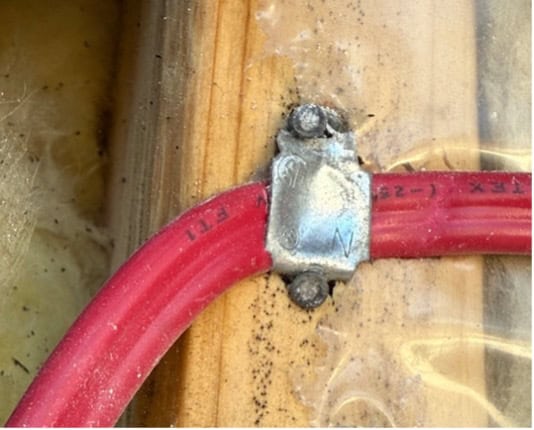
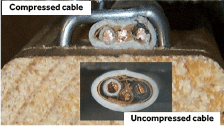
It has also been demonstrated that excessive compression of a cable—particularly by a mounting clamp—reduces the effectiveness of the electrical insulation surrounding the conductors. However, this degradation is generally less severe than that caused by a direct impact, such as a blow from a hammer.
Conclusion
Thus, several factors can directly influence the cause of an electrical cable failure. It is important to understand that such a failure rarely results from a single factor. For example, a cable that has been subjected to an impact—whether during or after installation—and whose conductor insulation has deteriorated due to operating conditions and the surrounding environment presents a significantly increased risk of fire caused by an electric arc between its conductors.
Finally, other factors that can lead to failure have not been discussed in this article. These include cable overheating caused by overloading and resistive contacts at mechanical joints, which will likely be the subject of a future article!
References
1 https://code-authorities.ul.com/wp-content/uploads/sites/40/2015/02/Investigation_of_Damage_and_Degradation_of_NM_Cables.pdf
2 https://code-authorities.ul.com/wp-content/uploads/sites/40/2015/02/Investigation_of_Damage_and_Degradation_of_NM_Cables.pdf
3 https://www.hydroquebec.com/data/documents-donnees/pdf/caracteristiques-moyenne-basse-tension.pdf