




For residential use, there are primarily three types of swimming pools: above-ground, semi-inground (or semi-above-ground), and inground. In-ground pools are generally at greater risk of damage than the other two types, as several factors can contribute to their deterioration. More specifically, they are vulnerable due to the type of surrounding soil and the presence of groundwater.
Here are the main types of failures that can occur in a residential swimming pool.
Causes Related to Human Activity:
- Inadequate maintenance;
- Missing or ineffective drainage;
- Objects left in the pool;
- Inappropriate treatment products.
Causes related to ground movement, water movement, or freeze-thaw cycles:
- Ice pressure or movement inside the pool;
- Freeze-thaw pressure outside the pool;
- Ground movement not caused by freezing;
- Pool uplift (water level lowered too much before winter);
- Hydrostatic pressure;
Causes of physical or structural damage:
- Manufacturing defect;
- Improper installation;
- Poorly designed landscaping;
- Puncture or tear in the fabric;
- Corrosion of the walls or fasteners;
- Deformation of the walls;
- Water leakage;
Here is a diagram illustrating some of these failures in an in-ground pool:
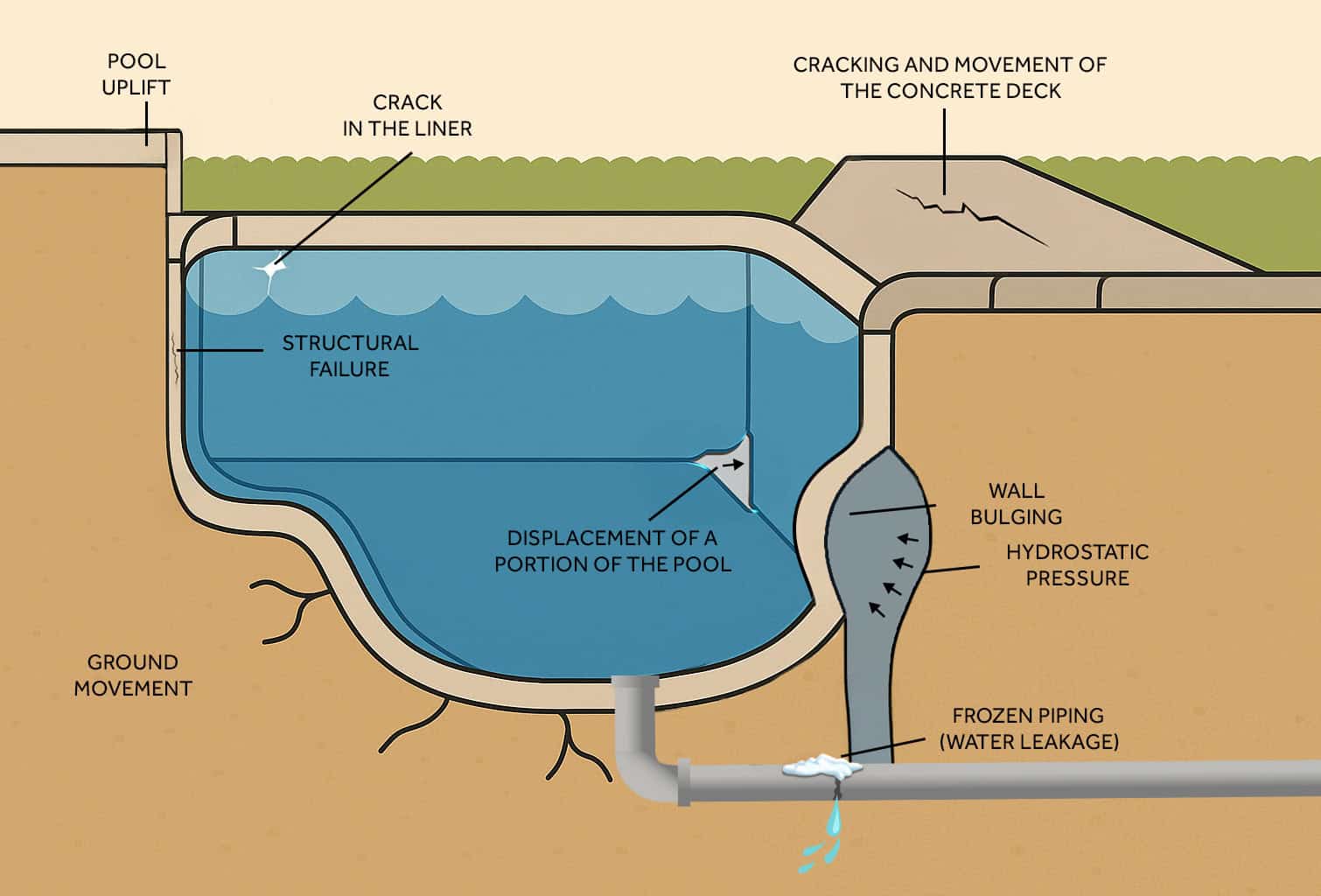
As can be seen from the list above, several types of failures must be taken into account depending on the circumstances, the type of pool, and the pool’s structure. Some pool structures are more susceptible than others to specific types of failures. For example, in the spring, when the groundwater level is higher than the water level inside the pool, a fiberglass monocoque in-ground pool is more likely to lift than a concrete pool. This is due to the relative lightness of the fiberglass shell, which is less dense and thinner than concrete, and therefore more vulnerable to hydrostatic thrust when the water level in the pool is too low to counterbalance the pressure exerted by the groundwater.
Example of Failure – In-Ground Pool
Consider the case of an in-ground pool with steel or composite walls and a concrete bottom. As this type of pool nears the end of its useful life, certain signs of failure may appear.
For example, when the pool is opened in the spring, bulges or deformations may be observed in the lower sections of the walls. These deformations can affect several sections of the pool. You would then notice that the surrounding coping has sagged in various places.
Faced with such a situation—in the absence of a bottom drain or drainage well, and thus with ineffective drainage—one might initially assume that this is due to frost heave during the winter. However, even if the winter was particularly harsh, it is unlikely that the frost would have reached only the deep areas where the observed deformations are located. In fact, freezing primarily affects the shallow parts of the pool, which would instead cause deformation of the upper walls and therefore does not apply to our case.
A more plausible explanation, given the pool’s age, would be corrosion or progressive stress on the anchors or supports of the panels holding up the walls. The failure of an anchor, for example, could allow the backfill—composed of clean stone—to exert pressure over the entire height of the wall that is no longer supported, causing the lower portion to deform inward. This initial deformation could then lead to subsidence of the surrounding sidewalk. Furthermore, the failure of one anchor increases the load on neighboring anchors, thereby accelerating a cascade effect of successive failures and deformations of the pool walls.
Targeted excavation near the edge usually confirms this hypothesis. Given the pool’s age—which is nearing the end of its useful life—this scenario is more likely than a design error or improper installation. In the latter cases, signs of weakness would have appeared much earlier, perhaps even shortly after installation.
Example of Failure – Above-Ground Pool
In the case of an above-ground pool, a typical failure scenario can be illustrated by the deformation of a panel caused by ground subsidence beneath the supports. These structures often rest on a bed of sand or rock dust. If this bed has not been properly leveled, compacted, or protected against erosion, a local loss of bearing capacity may occur over time.
However, once subsidence begins, water pressure—or hydrostatic loads—is no longer distributed evenly throughout the pool. The affected wall then experiences additional pressure—or localized overload—which causes gradual deformation that may eventually lead to a rupture. This rupture can result in the liner tearing, followed by a sudden release of water and damage to surrounding structures.
The long-term stability of an above-ground pool depends on several factors: the quality of the initial compaction, the uniformity of the subgrade, the effectiveness of drainage in limiting erosion and soil saturation, as well as the integrity of the mechanical connections (rails, posts, anchors, etc.). Periodic inspections help identify warning signs such as displacement, warping, or localized settling of the pool walls.
Standards and Best Practices
With regard to standards, there are U.S. standards governing the manufacture of swimming pools and their components, particularly regarding safety as well as in-ground installation for inground pools and above-ground installation for above-ground pools. Best installation practices should also be followed, in accordance with manufacturers’ recommendations. You can also refer to the National Plumbing Code (NPC) as well as municipal regulations governing the safety of residential swimming pools.
Troubleshooting by Process of Elimination
When there is limited information available about a pool—particularly when the owner has purchased a property where the pool was already installed—the cause of the failure is often identified through a process of elimination. By ruling out certain causes and types of failure, it becomes easier to determine the probable cause(s) of the problem.
Take, for example, the case of an in-ground pool with galvanized steel walls. The exact age of the pool was unknown, but it had undergone renovations approximately five years earlier, including the replacement of the walls, the liner, and the retaining anchors.
Following the winter, a tear in the liner was observed. During the visual inspection, several clues helped guide the diagnosis. An inward tilt of certain wall panels was visible, accompanied by detachment of the rail supporting the liner at the joints between the steel panels. The skimmer was also misaligned with the curb, indicating a shift in the structure. Additionally, a puncture in the liner was noted, precisely aligned with a joint between two panels. The area showed a puncture that had already been patched, suggesting that previous damage had been identified and repaired prior to the inspection.
Behind the repair, it was evident that the tear in the pool liner had been caused by the bolts securing the walls being punched through. This raises the following question: What caused the bolts to come loose and the walls to tilt?
By using a process of elimination, certain hypotheses could be ruled out. There were no signs of hydrostatic pressure or wall collapse. Similarly, no widespread ground movement was observed. The failure appears instead to be linked to a single cause or a combination of causes of progressive damage: possible corrosion of the fasteners, improper installation of the bolts, or frost heave in the soil behind the walls. Although the rupture of the geomembrane occurred suddenly, the underlying damage had developed over time.
Conclusion
In such a case, an inspection during pool removal would help determine whether the root cause is attributable to corrosion, freezing, or improper installation. This is a typical example where several combined factors lead to a failure and where the diagnosis relies on the methodical exclusion of other possible scenarios.
By the way, if you’re interested in this topic, don’t miss your chance to register for our training course, “Residential Pools: Understanding the Risks of Failure.” Edit or delete it, then start writing!