




Fatigue is an insidious phenomenon: the material gradually weakens under repeated stress until it finally fails.
How can you tell if a failure is caused by fatigue… and, more importantly, how can this phenomenon make a difference in your claim? That’s exactly where our experts and their state-of-the-art tools come in!
When a failure occurs in a seemingly unpredictable manner, our Keyence microscope takes center stage. Thanks to its ultra-high-resolution imaging capabilities—allowing for magnification of up to 2,500 times—it reveals the characteristic signs of a fatigue fracture.
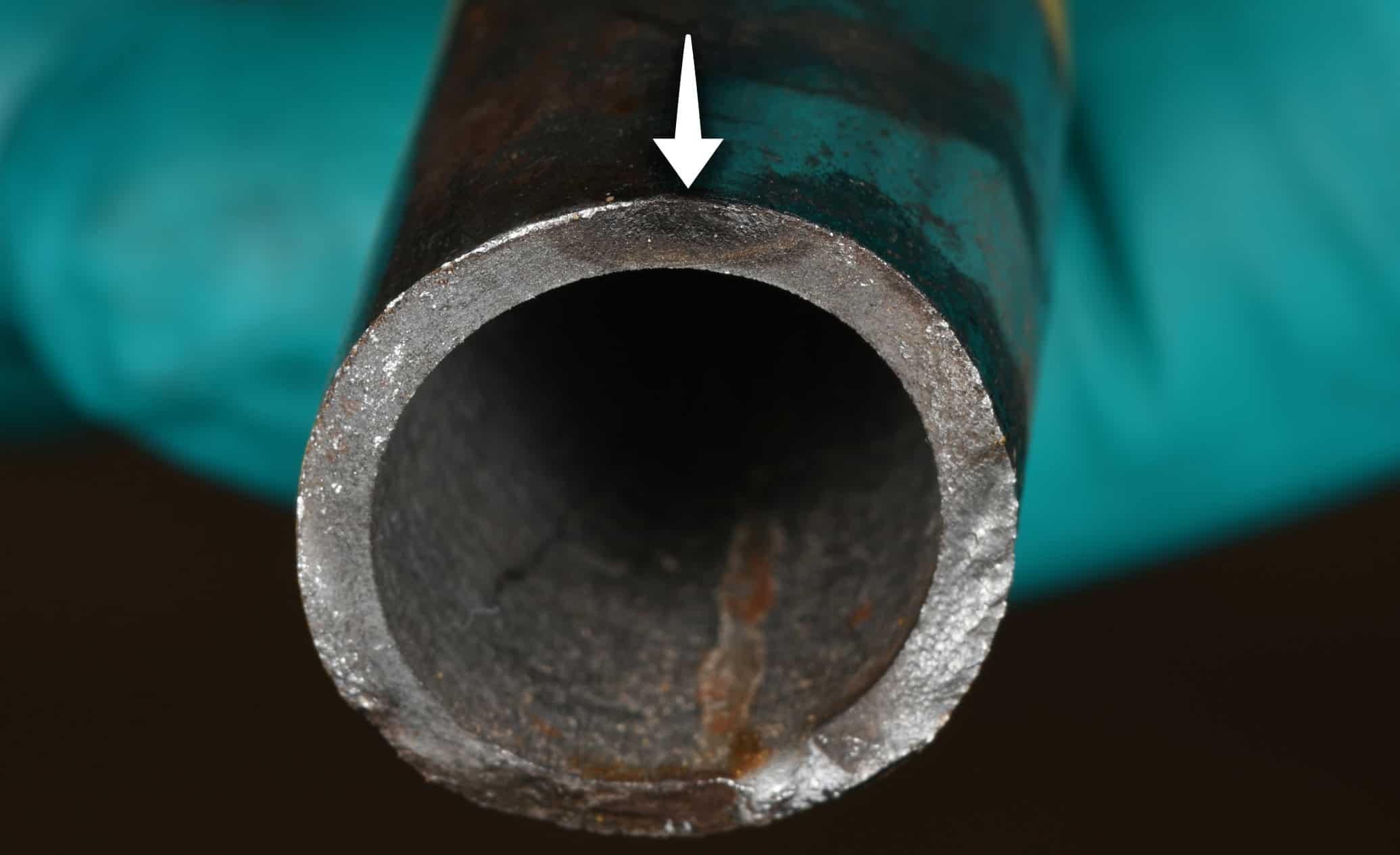
The Three Telltale Signs
- The origin of the break: You can see an off-center point where the stress is highest. An “off-center point” is simply a point that isn’t located exactly in the center, but rather offset from the middle.Imagine a bicycle wheel: if its central axle is perfectly aligned, the wheel will spin smoothly, but if the axle is slightly offset to one side, the wheel will spin unevenly. This is because the center point is off-center.
- Propagation streaks: These are visible on the fracture surface and indicate progressive, cyclic damage. When a part undergoes fatigue failure, it does not break all at once. Instead, the crack advances little by little each time the part is subjected to stress.Think of a sheet of paper being torn in stages. Each tear leaves a mark, showing where you stopped before starting again. It’s the same when you look at the marks on a pipe.
- Final failure: The material fails abruptly, causing the accident. This means that the crack has progressed far enough, little by little, to irreversibly weaken the part. This is the culmination of fatigue failure.These clues allow us to conclude that the part failed under the effect of repeated cyclic stresses—vibrations, intermittent loads—even if these loads were below the material’s strength limit.
And for the insurer, how does this change everything?
Recognizing fatigue failure is one thing. But understanding why it occurred is what makes all the difference in a claim.
That’s where our experts come in.
Example of fatigue failure on the bracket of a residential water heater pipe
To better understand how the involvement of an engineer or chemist specializing in materials can affect the available remedies in a claim, let’s consider the following example. A 60-gallon water heater installed in 2017 was mounted on a metal platform in a residential basement. The water heater included, among other things, a pipe that supplied it with hot water. Six years later, water damage occurred: one of the pipes in the “L”-shaped metal piping system burst. What happened?
Technical analysis
- Manufacturing defect: The expert’s analysis revealed a localized defect in the bend area, caused by poor manufacturing of the part. The bend area, in this case, is the part of a component that was intentionally bent during manufacturing. This results in permanent deformation.
- Aggravating factors: The water heater was improperly secured. This means it was not properly stabilized or positioned on its stand, causing slight vibrations in the affected pipe each time the water heater was used. These vibrations, though minimal, acted as load cycles characteristic of a fatigue mechanism.
- Consequences: These cyclic loads, repeated gradually over time, eventually caused the pipe to rupture.
Result
This fatigue failure resulted from a manufacturing defect combined with improper installation conditions. In this context, the claimant’s insurer may consider filing a claim against both the manufacturer and the installer.
Conclusion
Our analysis enables the insurer to fully understand the cause of the failure in several steps:
- Identify the fatigue failure;
- Understand the root causes (manufacturing, design, installation, maintenance, etc.);
- Determine the liability of a specific party;
- Provide the insurer with a technical opinion clarifying the potential liability of a third party;
- Guide decisions regarding potential recourse or justify/deny compensation.
In summary, this article has shown that fatigue failure can be identified by three key indicators: the off-center origin of the failure (think of a bicycle wheel!), the propagation lines that trace the crack’s progression (like a sheet of paper), and the final fracture that occurs when the part becomes too brittle. What’s the takeaway from all this? Fatigue failures aren’t random: they result from a combination of factors—such as a manufacturing defect and improper installation—exacerbated by repeated stress.
Ultimately, with the right analysis, we can not only determine the exact cause but also identify potential solutions.
At Origin, our materials experts are able to detect signs invisible to the naked eye and help you understand the technical concepts behind the scientific phenomena involved.
When faced with a fatigue failure, rely on our expertise. Contact us at info@origin.expert to entrust us with a new project.